
Local SEO for Law Firms:
Rank First in Your Area
How to dominate local search results, appear in the Google Map Pack, and attract more clients in your city — without a huge budget.
Local SEO helps your law firm show up when potential clients search for terms like "divorce lawyer near me" or "best personal injury attorney in [city]." It's how local clients find you — and if your firm isn't showing up, someone else is.
When your firm ranks high in local search results or appears in Google's map pack, you're far more likely to get calls, consultations, and new cases. In fact, 71% of people looking for a lawyer say it's important to have a local attorney.
The good news? Ranking locally doesn't require a huge budget — just the right strategy. You'll learn how to:
- Optimize your Google Business Profile to appear in the local map pack
- Build high-quality location pages that target nearby clients
- Earn local citations, links, and reviews that boost your visibility
- Get the coveted Google Screened badge for LSAs
- Track what's working (and improve what's not)
- Use AI to automate and scale your local SEO
What Does Local SEO Mean for Law Firms?
Local SEO for law firms is the process of improving your firm's visibility in local search results — especially the Google Map Pack, Local Services Ads (LSAs), and organic listings for geo-specific legal queries.
Think: "best injury attorney in [city]" or "divorce lawyer near me." You want to show up #1 here:
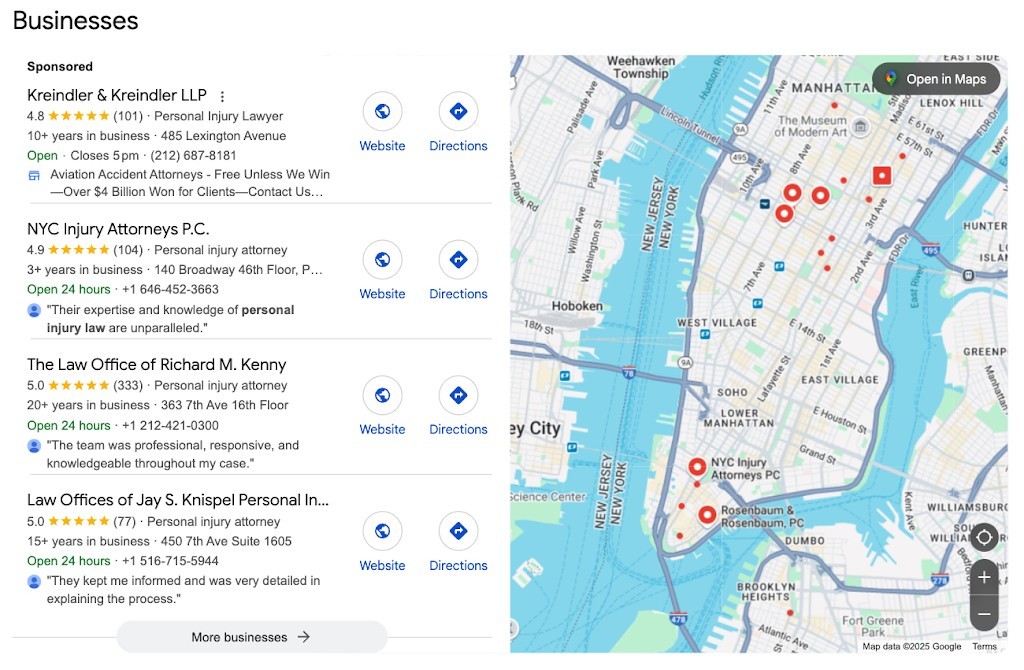
When someone types those searches into Google — or even asks ChatGPT for a local recommendation — the firms that show up first get the call. These aren't random results. They're earned through consistent local SEO efforts.
That's why local SEO is no longer optional. It's how legal clients find and choose firms before they ever speak to a lawyer. And it's how your competitors are quietly closing cases day after day.
1 Create Your Google Business Profile for Local Law Firm SEO
Your Google Business Profile (GBP) should be the foundation of your law firm's local SEO strategy. It's the top factor influencing whether your firm appears in the local map pack — yet it's often treated like a one-time task.
Claiming and verifying your profile is just the beginning. To rank well and attract more clicks, your profile needs to signal authority, trust, and relevance to both Google and potential clients.
Here's how to do it right:
- Ensure your NAP is 100% consistent: NAP stands for Name, Address, and Phone Number. Every detail should match what's on your website, down to punctuation and spelling. Inconsistencies confuse Google and weaken your authority.
- Choose the right categories: Your primary category should reflect your exact legal focus — e.g., "personal injury attorney" instead of just "attorney." Add relevant secondary categories to cover all your services.
- Write a compelling business description: You have 750 characters to showcase your firm's expertise, awards, service areas, and unique value. Go beyond "free consultations" — explain how you work with clients and what sets you apart.
- Add at least 10 high-quality photos: Include shots of your team, your office, and you at work. Profiles with people-centered photos earn up to 300% more clicks.
- Leverage the FAQ section: Most firms skip this, but it's a hidden gem. Answer common client questions directly on your profile to boost engagement. Sprout Media's AI can automatically generate the most effective questions and answers based on competitor analysis.
When fully optimized, your GBP tells Google that your firm exists — and shows why you're the top choice in your city or region.
2 Create High-Value, Location-Specific Website Pages
Next, check your website's local landing pages. These tell potential clients why they should work with you instead of a rival firm in your area.
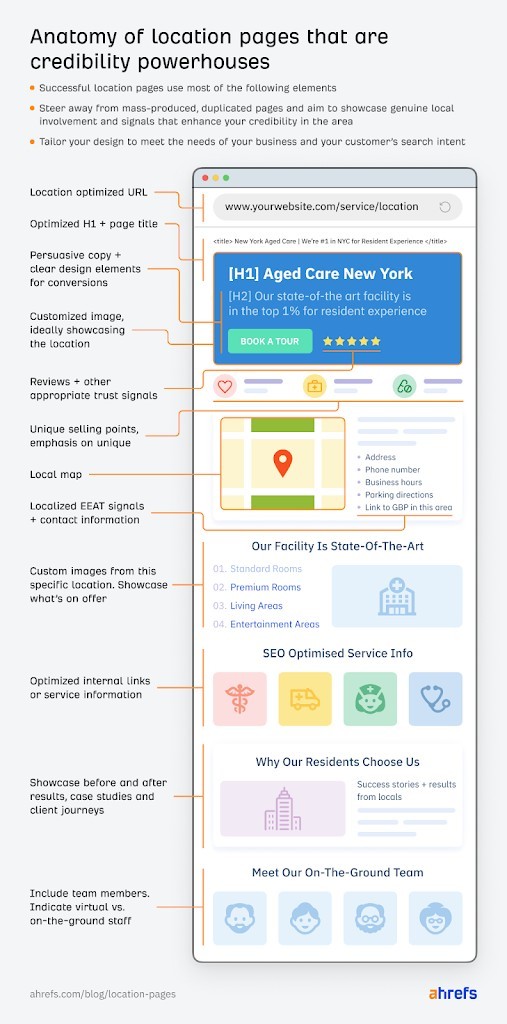
This is where many firms struggle. They copy and paste one location page, swap out the city name, and expect it to rank. But Google is smarter than that — it can tell when a page is duplicated with no real local value, and it won't reward it with top rankings.
Here's what high-performing local pages include:
- Unique content for each city or region: Don't just change the city name. Write about local landmarks, courthouse locations, recent legal news, or common legal issues specific to the area.
- Localized trust signals: Mention community involvement, speaking events, or media appearances in that region to establish local relevance.
- Embedded Google Map: Add a live Google Map showing your office location or service area to reinforce proximity.
- Local business schema markup: Add structured data that tells Google exactly which areas you serve and what services you offer in each location.
Sprout Media helps automate this process by building unique, SEO-friendly local pages tailored to your practice areas and target cities.
3 Build Powerful Local Citations and Directory Listings
Once your Google Business Profile and local pages are in place, it's time to reinforce that trust and authority across the web. Think of citations like online business cards. They often look like this:
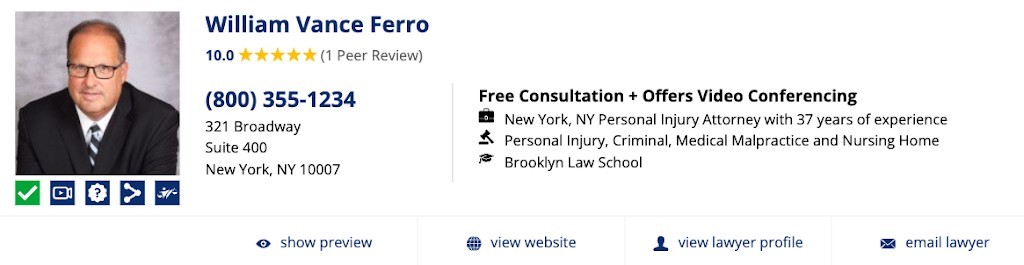
Start with the big legal directories: Avvo, Justia, FindLaw, and Lawyers.com. Then branch out to mainstream and local directories like:
- Yelp
- Better Business Bureau
- Chamber of Commerce
- Local business directories in your city or region
The most common mistake law firms make here? Inconsistent NAP information across profiles. Even small formatting differences (like "St." vs. "Street") can dilute your local authority in Google's eyes.
- Standardize your NAP across every listing — make sure it matches your Google Business Profile and website exactly.
- Use tools like Yext or BrightLocal to manage and monitor your citations at scale.
- Claim and complete each profile: include services, hours, photos, and a strong business description to improve trust and click-through rates.
At Sprout Media, we integrate automated citation management into your local SEO workflow — so you can focus on your practice while we ensure your listings stay accurate, optimized, and consistent.
4 Get the Google Screened Badge for Your Law Firm
Want to appear above the map pack and organic results? Google Local Services Ads (LSAs) with the Google Screened badge are the only way to get there — and only a small percentage of law firms have earned it.
This badge shows potential clients that you've passed Google's background checks and license verification. It builds instant trust and boosts visibility at the very top of local search results.
It matters because you'll get:
- Higher placement: LSAs appear at the very top of local search results — above both PPC ads and the map pack.
- Better click-through rates: Searchers trust Google Screened firms more than unverified competitors.
- More qualified leads: Clients see you as vetted and verified before they ever contact you.
To earn the Google Screened badge, you'll need to complete an identity and license check through Google's LSA partner, submit insurance details (depending on your practice areas), and maintain positive reviews and a strong reputation.
Sprout Media helps streamline this verification process and keeps your LSA profile competitive over time.
5 Generate and Manage Reviews for Your Law Firm
Nothing builds trust faster than real client feedback. When someone searches for an attorney, reviews are often the deciding factor — especially for high-volume terms like "employment lawyer with great reviews near me."
Great reviews boost your local rankings, improve click-through rates, and help clients feel confident before they even speak with you.
- Ask frequently: After each successful case, request a review while the experience is still fresh.
- Make it easy: Provide a direct link and step-by-step instructions so clients don't have to spend much time on it.
- Respond to every review: Whether glowing or critical, a reply shows professionalism and engagement. Be polite, even if the feedback stings — potential clients are watching.
6 Develop an Authoritative, Hyper-Local Content Strategy
Generic "how-to" articles and high-level answers to situational questions won't cut it for local SEO. You need content that proves you're embedded in the community — not just operating across the country.
- Hyper-local topics: Write about nearby court rulings, local legal news, or community events where you've presented.
- Neighborhood insights: Reference landmarks, precincts, or local regulations to show on-the-ground expertise.
- Local expert interviews: Spotlight area judges, mediators, or past clients (with permission) to reinforce your connections.
- Geo-tagged assets: Embed maps, local images, and schema markup to tie content to specific locations.
This localized depth moves the needle with both Google and potential clients. Sprout Media's AI can help you uncover the most resonant hyper-local topics at scale — by analyzing what's working for your competitors and reverse-engineering the best local content for you to publish.
7 Acquire Quality Local Backlinks to Boost Your Authority
Backlinks are a top-ranking factor, but for local SEO, where the link comes from matters just as much as getting one. You don't need mentions from Forbes — you need links from trusted local sources that prove you're part of the community.
High-value local link sources include:
- Local news sites and legal publications
- Chamber of commerce or business associations
- Local charities, events, or sponsorships
- Interviews or guest posts on community blogs
These links point to your location pages or local blog content and send strong proximity signals to Google. Sprout Media identifies local backlink opportunities based on your practice area and region. Our proprietary AI system then helps you pursue them efficiently — without cold pitching every newspaper in town.
8 Leverage Social Media for Enhanced Local Visibility
Social media activity won't directly improve your local map ranking, but it does help validate your presence in the community. Google looks at signals from across the web to confirm that your business is legitimate and locally active.
What matters most isn't follower count or viral reach — it's consistency and relevance. Posting updates, engaging with local events or organizations, and sharing client success stories show that you're active and trusted in your area.
That ongoing visibility helps strengthen your broader digital footprint and reinforces your local authority, especially when your business info (name, address, and phone number) is consistent across platforms.
Next Steps: Implementing the Framework (DIY or with Sprout Media)
Executing this local SEO strategy is effective — but doing it consistently requires time and focus.
That's where Sprout Media helps. We automate key steps — from GBP management and citations to location page creation and performance tracking — so your firm appears higher, more frequently, without the manual effort.
Whether you do it in-house or want expert support, the important thing is to start. Each month you wait, another firm is gaining ground in your market.
If you want to automate your local SEO efforts, book a free strategy call with Sprout Media. We'll audit your current local presence and show you your biggest growth opportunities.
→ Continue: Keyword Research for Law FirmsFAQ
Everything law firms need to know about local SEO — from Google Business Profile to the Google Screened badge, citations, and monthly costs.